
GROSS EXTRAS - Moby Dick, Walter Benjamin and Eugene V. Debs
Now, in between the movie essays: interesting links, quotes and shorter pieces…

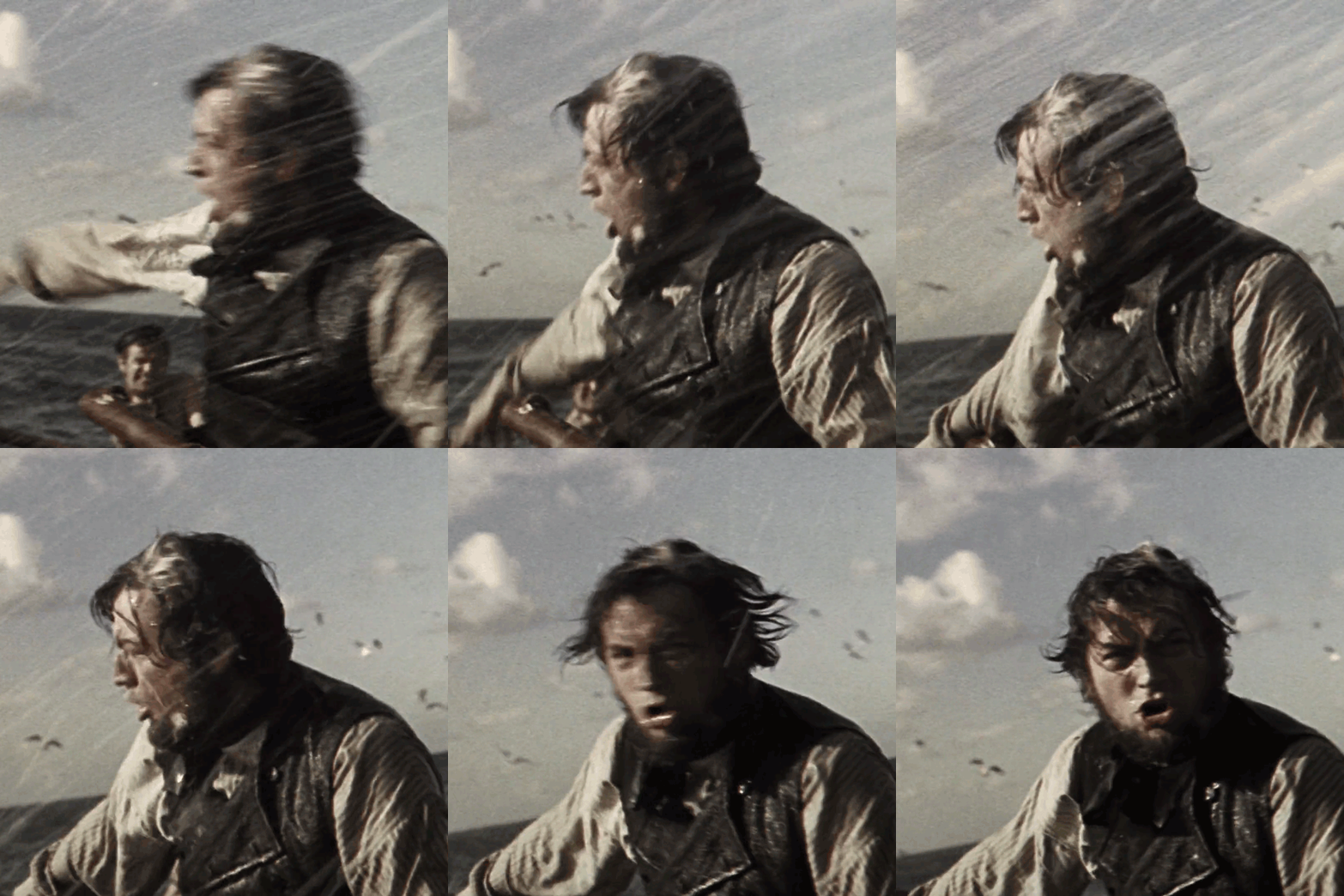
The GROSS reviews are now mostly for paying supporters so I’m going to publish these occasional supplementary pieces for everyone. This one is part two of my Jaws review and starts with a bit more about Moby Dick…
The other Moby Dick movie
Jaws, as we now know, is an adaptation of Moby Dick. In fact it’s one of a very small number of movie adaptations of the novel and, as far as I can tell, there’s only ever been one that carries the name of the book. John Huston made his Moby Dick in 1956. As you’d of expect, it’s a big-hearted, rather direct kind of thing, full of passion for the subject matter. Huston, like Spielberg, doesn’t even try to take on Melville’s big themes, though, and this may be because Melville’s big themes are mostly, well, too big. Things like ‘eternity’, ‘infinity’, ‘damnation’ and so on. A filmmaker in their right mind wouldn’t even try. Huston’s big mistake, though, is in the casting. He shot the film in Wales and Ireland (and the seagoing scenes off Madeira) and, presumably for some very sensible commercial/contractual reason, cast only three Americans: Gregory Peck (let’s face it, an entirely inappropriate Ahab); Huston’s friend Orson Welles, who provides an oddball sermon in the harbour church and then is heard from no more and Richard Basehart, who brings an inappropriate heartthrob vibe to Ishmael.
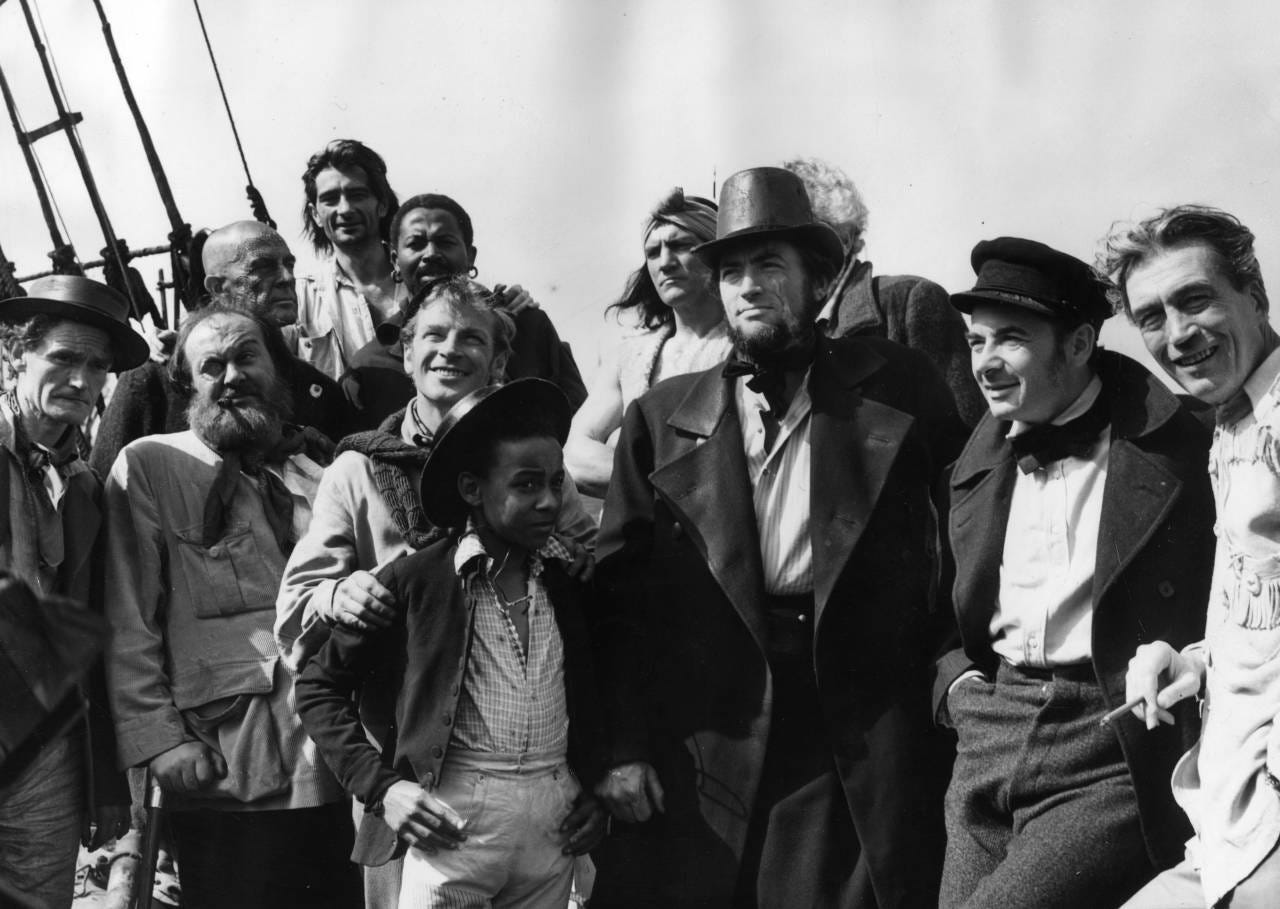
In the wider cast, Huston has chosen for this movie a kind of repertory company of British theatrical actors; and these are not just any actors. Between them, they already have years at sea (or at least years in military service). And here’s the problem - that experience is largely in the British army and the British navy. Click around Wikipedia a bit. It’s kind of remarkable:
James Robertson Justice as Captain Boomer - Royal Naval Reserve, fought on the Republican side in the Spanish Civil War, raced cars (quite a character!).
Harry Andrews as Stubb - Royal Artillery and Liverpool Playhouse; ‘Ice Cold in Alex’.
Bernard Miles as the Manxman - Pembroke College, Oxford and ‘In Which We Serve’.
Noel Purcell as Ship’s Carpenter - Gaiety Theatre (probably shouldn’t be on this list, since he’s Irish).
Mervyn Johns as Peleg - RADA, Royal Air Force and practically every British film of WW2, including ‘Went the Day Well’.
Joseph Tomelty as Peter Coffin - another Irishman but he was in David Lean’s ‘The Sound Barrier’.
Tom Clegg as Tashtego - Household Cavalry and professional boxer (and Oddbod in Carry on Screaming obvs).
(and Friedrich von Ledebur as Queequeg who did serve but, to be honest - as a cavalryman in the Austro-Hungarian army - on the wrong side).
You can see the problem. Nothing about service in the British armed forces, especially in the Navy - the ‘senior service’, the world’s police force for centuries - could possibly fit you to life on a whaler. Especially not to life on Melville’s existential whaler.
The military demeanour of almost the whole cast of Huston’s Moby Dick is all wrong: so many straight backs; so much respect for chain-of-command; so much obvious Naval discipline. Squint a bit and you can see the officer cohort of the Pequod gathered, soaked to the skin, on the bridge of a North Atlantic destroyer, scanning the horizon for u-boats.
Walter Benjamin in Moscow 100, years ago this month
I read this in Daniel Mourenza’s Walter Benjamin and the Aesthetics of Film. The influential German philosopher and critic (a second-tier member of the Frankfurt School) travelled there to watch Battleship Potemkin, released in the previous year, for a review he’d been commissioned to write for Die Literarische Welt in Berlin. It’s a long story, but he wound up watching three important Soviet films, all in one session:
Benjamin spent five hours in a small screening room in the company of only a translator. The programme consisted of three films: Mother, Battleship Potemkin, and Yakov Protazanov’s detective comedy The Three Million Trial (1926). Benjamin was exhausted, leaving the room before the third film ended. The last film, a comic thriller based on a play by Italian author Umberto Notari, starred Igor Ilyinsky, an actor he had seen a few days prior, in a film he detested. Benjamin, in fact, had attempted to watch Battleship Potemkin weeks earlier, on 16 December. However, when he arrived in the room in which it was being screened, the film was entering the final act. Benjamin did not enjoy watching Potemkin for the second time. In his diary, he recorded that it had been ‘an exhausting, unpleasant day in every respect’, describing it as ‘quite a chore sitting through that many films in succession with no musical accompaniment.
I wonder if I should put on a shared screening of one of those movies - perhaps Mother, which I think I can obtain in decent quality - here on Substack on 24 January, which is the anniversary. What do you think? Would you watch with me?
The other New York socialist - a t-shirt
In non-movie news, I’ve come up with a t-shirt design that uses the original logo of WEVD, a New York radio station founded in 1927 that has the initials of socialist leader, three times US Presidential candidate and founder of the Wobblies, Eugene V. Debs in its callsign. On the front is the station’s 1942 logo and on the back a famous quote from Debs: “While there is a lower class, I am in it, while there is a criminal element, I am of it, and while there is a soul in prison, I am not free.” The station was bought and sold many times and finally lost its call-sign and disappeared in 1989 (at Zazzle you can, of course, have the design printed on practically anything else, from a bucket hat to a mousemat to a cook’s apron). Also, the version on Redbubble is a bit cheaper but doesn’t have the quote on the back).

Follow me on Letterboxd.
More GROSS merch!